
An experiment in progress with Severn Church, Bristol to share relationships with Jesus through experience.
As I understand it, the church exists to introduce people to Jesus.
“How?” is a really good question, but let’s start with the even more important “Why?”
You know this feeling you have that the world could and should be better? (I’m presuming here, but I don’t think too much, because everyone has this.) Jesus stepped in to address this in a unique way at an interesting place and time.
Imagine, if you can, a society where some people luxuriated in comfort while most others toiled in poverty with little security as their world was changing around them.
A small but once proud nation was struggling under the burdens of difficult relationships, including an overbearing power whose “peace through strength” was extracting their money and labour under the authority of megalomanic leaders who used to be elected republicans but increasingly saw themselves as dictator kings, even gods.
People in this small nation could not agree on how best to deal with this. Some looked to past glories and traditions, while others had a sense of a more progressive future. They weren’t completely polarised – they shared a lot of distinctive ideas, festivals and feast days together, along with an unusual belief that there was only one God rather than lots of different gods – but they weren’t united enough to share an agreed solution to their problems, and so their problems remained.
About 2000 years ago, Jesus stepped into this situation with answers that were, surprisingly, both expected (the climax of a story and the fulfilment of promises written down centuries earlier) and yet completely unexpected (nobody guessed this is how it would all turn out.)
Jesus promised the better life that people were looking for then, always had been, and still are.
While I’m guessing you’ve heard of him, and might even know some of his teaching about the importance of love, etc, it might surprise you to know that Jesus didn’t offer his ideas as the solution to our problems.
He offered himself.
“I am the way, the truth and the life,” he is recorded as saying in John’s gospel.
So why introduce people to Jesus? Because that’s the way to the better life he promised and, I believe, showed through demonstrations of how poverty, sickness, injustice, isolation, prejudice and many other forms of suffering could all be overcome. Following Jesus, people could see how even death could be defeated. That was more than anyone could reasonably expect.
If that’s the “why?”, what about the “how?” How can we possibly experience life with Jesus today and share it with other people?
In most churches I’ve experienced, this is done through a mixture of teaching and practice, but teaching tends to lead the way. Picture your idea of a church leader. What are they doing? I hope you have experience of one who is so good at building relationships, that’s your main impression of what they do best and value most. But that is hard to do on a large scale, so in our industrialised Western culture, we’ve often prioritised and given platforms to leaders whose main talent is the sharing of ideas.
There’s nothing wrong with good teaching or the sharing of ideas – I’m writing this to share ideas with you! And there are certainly good examples of effective teaching-led ways to share Christian faith, like Alpha. I’ve enjoyed being an Alpha participant and leader several times, and seen a range of people start or boost their faith in Jesus as a result.
Courses like Alpha have real strengths, especially (in my view) the relationships that can form around sharing food and chatting about life and the teaching material that’s presented, whether or not people agree with it all.
But I’ve also seen many people who don’t connect with that approach. They’re not buying the message that looks like it’s being sold to them, or accepting the premises of what is being argued to them.
Could that be because we’re moving from modern mindsets that value reason and respect authority to postmodern ones that (also) value feelings and question authority? I think that’s quite likely, but I don’t think it’s important to have to know for sure.
What I do think is important, which I believe many at Severn have also thought for a long time, is that talk-centred approaches aren’t sufficient to introduce people to Jesus, any more now than they were in the time of Jesus, whether people met him in the flesh or not.
From our great distance away, seeing the first century church through literature which was mainly written decades after Jesus’ personal ministry, it looks like reading books and letters about Jesus might suffice to get to know Jesus. Doesn’t it have to?
Not according to those books and letters themselves. They describe much more practical, personal experiences, including the stories of people who met Jesus and were changed through their encounters.
What changed them? Abstract ideas? Carefully made arguments? That seems as unlikely then as it does now. When was the last time you changed anyone’s mind about their view of a sensitive, personal topic – the kind that causes real division, strong feelings and intense suffering – by proclaiming your winning argument at them? (Sure, there are a few stories in the New Testament about people coming to faith after hearing someone talk, but only – as far as I can see – when that’s also accompanied by the sharing of experience and, I believe, the movement of the spirit of Jesus to meet people where they are.)
People who have been researching how minds change have been telling us for years, though, that reason and arguments are often more effective at entrenching people where they are than moving people into new ways of seeing things. Is that what we want? Is that the best we can do, or the best God can do with us?
I think we’ve been building an appetite to try something else for a long time. It’s not coming with any grand claims that this is going to replace anything that churches have been trying for years, but I hope it can help us to get a bit closer to what Jesus’ first followers saw and heard, thought and felt, when they met Jesus and saw lives change. This is a genuine, open question – can that help us to introduce people to Jesus and see lives change too?
Here’s what we are trying, specifically:
On an evening, a small group of people interested in Jesus gets together to share food, start to get to know each other and chat about life (so far, so same as Alpha and other similar experiences!)
We provide a few suggested conversation starters that touch on topics relevant to the people that will feature in an ‘encounter’ story that’s the centrepiece of the evening. These are big topics, like our attitudes to money, or our sources of security and identity, that we could probably explore over a long time and won’t get wrapped up neatly over a dinner. Good! We’re not aiming to dispense taught answers to tough questions here, but get ourselves thinking about what our big issues really are. We’ll see other people who also have these issues in the stories we share.
For the ‘encounter’ story itself, which is a gospel story of Jesus meeting people, we set the scene by describing the time and place where it happened and invite people to picture it, and the characters involved, as vividly as possible. We share a minimal amount of info needed to help people see this the same way as the people who were there at the time, perhaps including a little history for context. For example, when Jesus met a Samaritan woman at Jacob’s well, it helps to picture this on a mountain that has a history of housing a temple that was built by people who shared ancestry with Judeans but were excluded from worship with them. The encounter Jesus had here was with an outsider among outsiders, and someone in our group might relate to that, either for themselves or someone they know and love. Here’s a sheet I made to illustrate for this story.
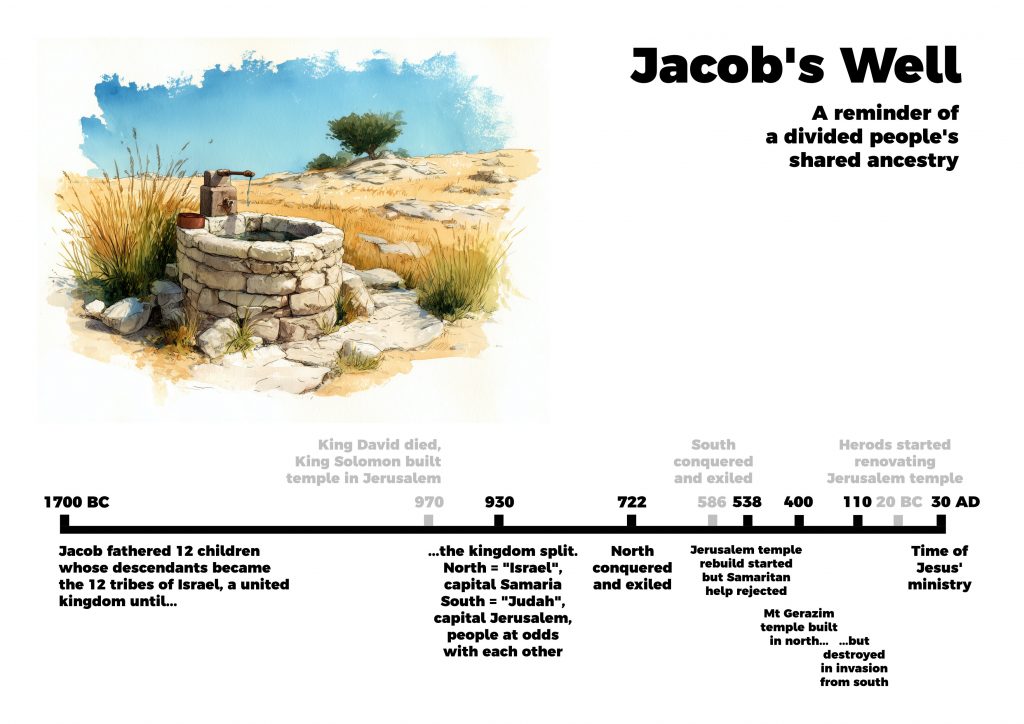
We then create some space for reflection, physically and mentally. We get comfy and listen, with time to picture the scene, and then listen to the story. I’ve written music to underscore it, which then continues afterwards so people can stay in this scene after the story ends. We invite people to reflect on what they heard, see how it connects with people and issues important to them. Then we ask people to focus on Jesus – in particular, this Jesus from this story in this setting. If you were there, what would you ask him?
Here’s the story part of the audio we used, taken from “Time, Space, Jesus,” my audio version of John’s gospel:
From there, we can go a few ways. It might be that we get right into prayer with Jesus. People can ask him directly whatever they want, and it might be nice and polite like church prayers, or it might be a bit more messy. I expect we’ll get emotional sometimes. I wouldn’t be surprised if people – once we’ve got to know each other, at least – bring up what’s really on their minds, and if that includes frustration, so be it.
We can also (as we did in our first tryout session) just stop for a bit and chat. What came to mind from that story? How do we relate? Does it touch on our experience, or that of anyone else we know and love? After digging as deep into this as people want to, it’s also a good time to get into prayer and see what happens.
By anchoring all of this in experience, specifically the experience of people in the Bible who met Jesus and working out for ourselves how we relate to it, I think we’ll be able to introduce people to Jesus in ways that teaching can’t do on its own, and hopefully avoid some of the issues that arguments bring up.
To be honest, though, I have no idea right now how well this might work. All I can share so far is that our first discussion about a woman at a well led to my thirst for Jesus’ “living water” massively growing, which includes my desire to get on with sharing the seeds of possibility with stuff like this with someone like you, who has read to the end of a long bit of blurb. Thank you! I pray that you can also meet Jesus, find what you want to ask him, and feel like sharing that experience yourself.