Story with voicing and illustrations for Severn Church, Bristol.
How can we share what “God’s kingdom” is about with a really wide audience?
Once a month at Severn, we gather the whole range of kids and adults together for a fun morning of playing, singing, crafts and story sharing. It’s always a good opportunity for us serious grown ups to think about our serious things in new ways, sometimes a lot less seriously, but still connecting with important stuff about faith and life.
In September 2025, fresh back from summer holidays, the team was looking around for videos to show what it meant to be fully invested in life with God. Some were hard to clear rights for, others had good bits of message but weren’t quite right.
So I offered to write a story and make a video for it, with about a day available. I had to confess it wasn’t a totally original story – it’s basically one that Jesus told – but it’s adapted for our situation.
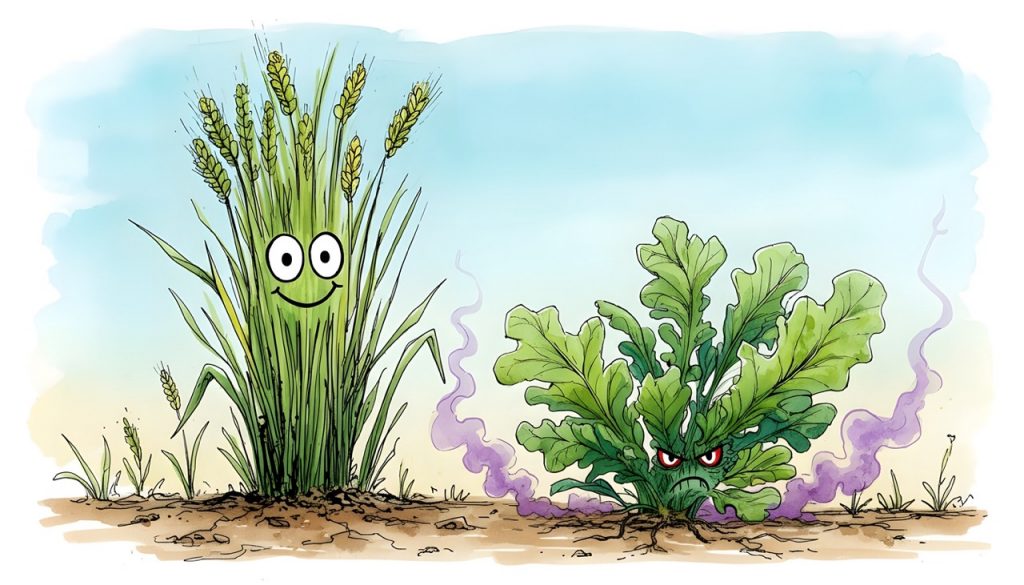
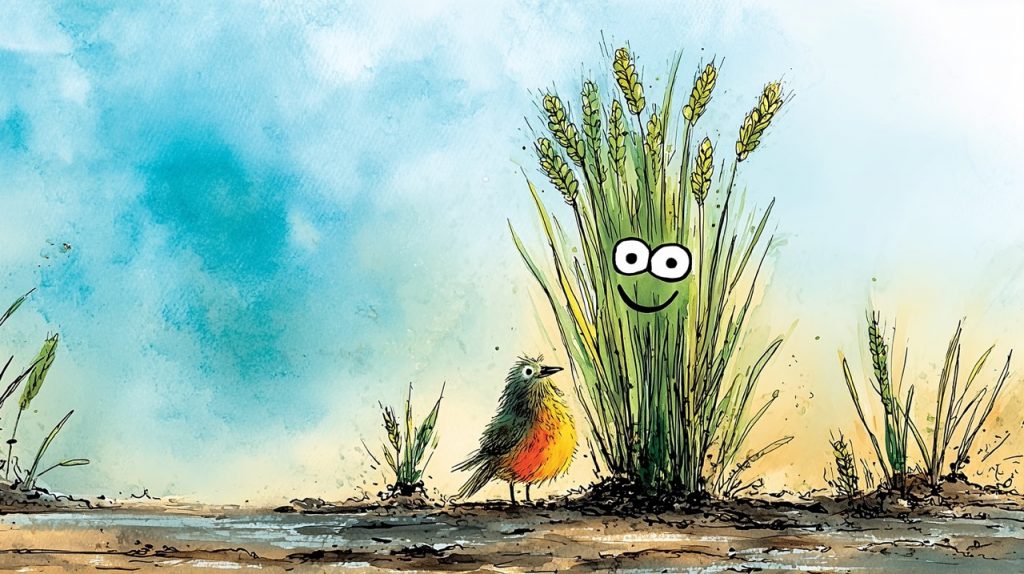
It’s about wheat that is planted in a field by a farmer, struggles to grow but eventually becomes as tall, fruitful and supportive of life as the farmer intended.
However, it’s not the only life in the field. A very different kind of plant grows alongside which is very good at protecting itself, but that’s about it.
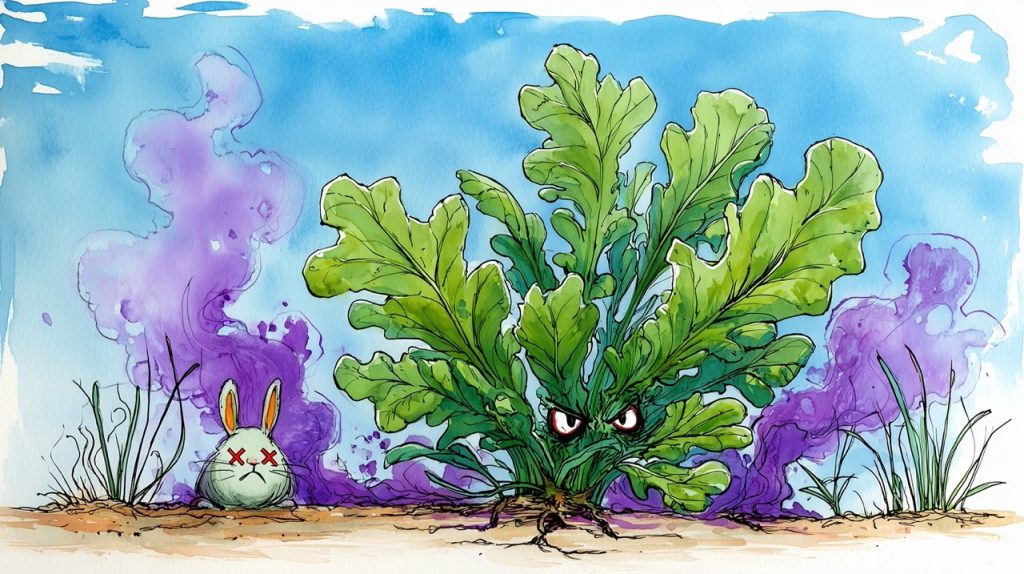
These two kinds of life stand in contrast to each other, not just for what they look like or how they interact with the world around them, but also for what they eventually lead to, and the life they support for the long term.
There are different bits of Jesus’ teaching mixed in here, but they all point towards a quality of life that he offered and demonstrated through his life, death and resurrection. I’m hoping that’s easy to recognise, and that it can make us think about the kinds of life that we can choose too.
The writing and voicing were the quickest bits. The illustrations took most of the time.
AI helped a lot, but it’s not always famous for its consistency, and I needed about 20 pictures that were consistent enough to tell the story with characters a viewer could follow all the way through. Early generative AI wasn’t up to this, but Midjourney was starting to get pretty good.
Even so, I was pretty fussy about some of the details and how I wanted it all to look and feel, and while Midjourney has some editing tools, the end results could be pretty random.
Thankfully, Google’s Nano Banana had just become available and turned out to be a great finisher for lots of the pictures. I discovered that it was nowhere near as good a starter as Midjourney, but they worked really well together as a team.
Here is the finished story!