
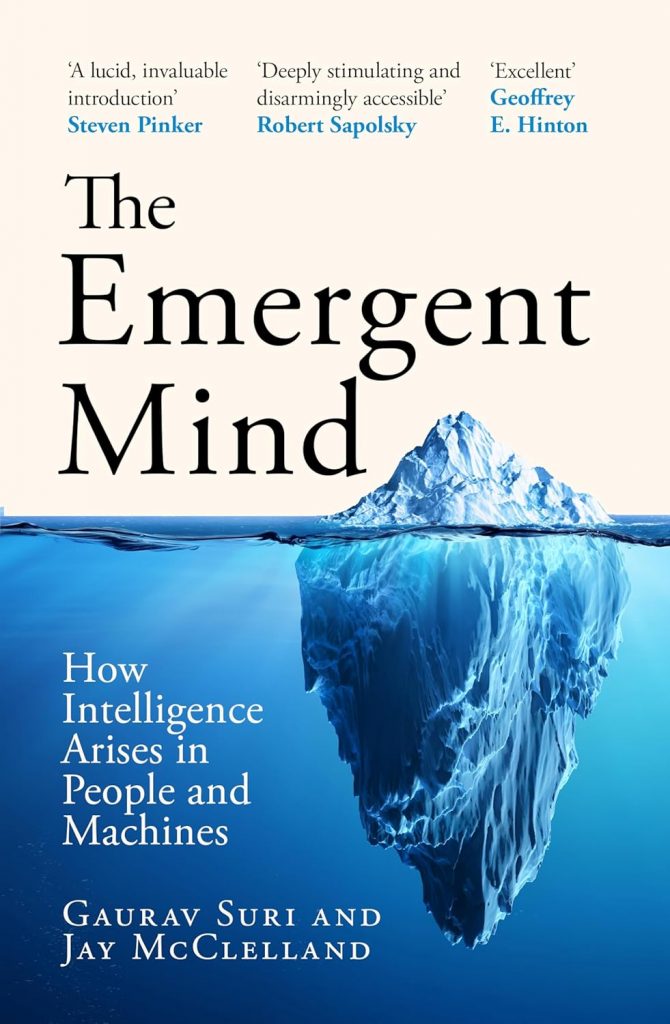
The Emergent Mind: How Intelligence Arises in People and Machines by Gaurav Suri and Jay McClelland
What it’s about
Not everything that’s made is built as deliberately as we might think. “Emergent” describes a property or behaviour that a collection of things has which its individual parts do not. It can describe the way a group of ants collectively works out the shortest path to food, and how a flock of birds can synchronise its movements.
Emergence might also be the best way to describe how our brains, with their huge collections of fairly simple neurons, produce our minds with incredible experiences of consciousness and intelligence.
Why it’s interesting to me
Research for “The God of Rainbows” led me into exploring the importance of diversity and complexity within ourselves, as well as among ourselves. The idea that defining features of who we are could be described as emergent seems fascinating, and very different from ideas I think I inherited about nature and nurture.
I’m also interested and a little bit involved in the development of Artificial Intelligence, and what we learn from that seems to have huge potential both to help and challenge ourselves. Understanding emergence as a principle seems important to understanding AI because of its otherwise impossible complexity. Will getting our heads around this, a least a bit more than we do, help us get closer to understanding the possibilities and pitfalls of where AI is heading? And could learning from this help us get to grips with some of the mysteries of consciousness itself?
How I’m getting on
About three chapters in so far. Loving it, even in the heavy explainer-type parts that introduce the neuroscience we need to know for the rest. Will report back with more later.